PAKHREEN JOURNAL
Thoughtful engineering, design, and digital systems.
One Frontend, Many Backends: How Modern Applications Connect React, Next.js, .NET, Python, Java and Node.js
When people talk about building a modern web application, they often think about the frontend and backend as if they must be built using the same programming language or technology.
That's not how modern software systems have to work.
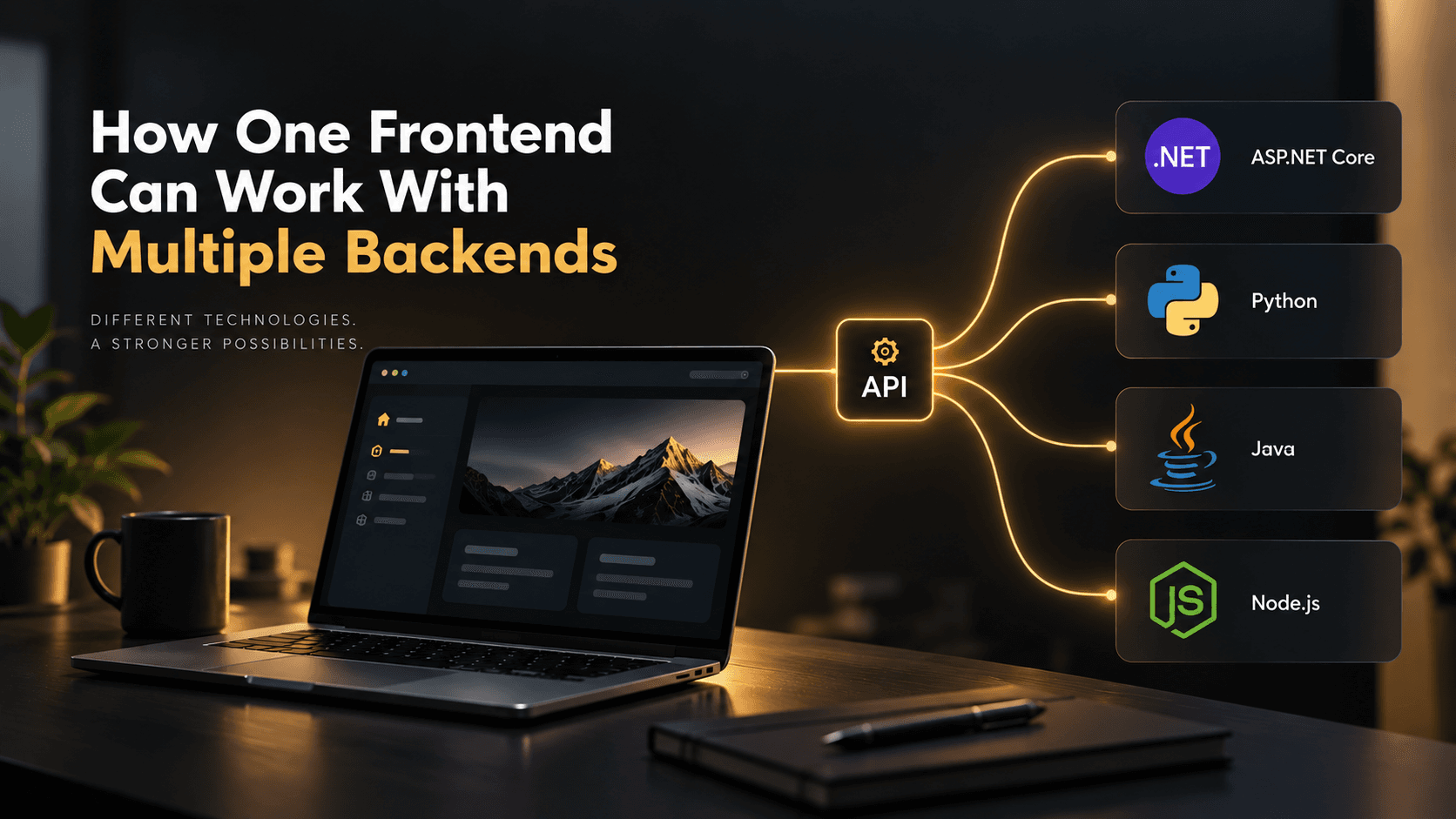
A frontend built with React or Next.js can communicate with a backend built using ASP.NET Core, Python, Java, Node.js, or another technology entirely.
The two sides don't need to speak the same programming language.
Instead, they communicate through well-defined interfaces such as APIs.
This separation gives developers and businesses significant flexibility when designing software systems. A company can choose the technologies that best suit different parts of its application without being locked into one programming language or framework.
For example, a business application could have:
Frontend: React / Next.js
Backend: ASP.NET Core
Database: PostgreSQL
Authentication: Dedicated authentication service
Payments: Stripe
File storage: Cloud storage
Another application could use:
Frontend: Next.js
Backend: Python
Database: PostgreSQL
AI services: Python-based services
And another could use:
Frontend: React
Backend: Node.js
Database: MongoDB
The user experience can remain largely the same even though the technology behind it is completely different.
So how does this work?
Let's take a closer look.
Frontend and Backend Have Different Responsibilities
Before understanding how different technologies communicate, it helps to understand what the frontend and backend actually do.
The frontend is the part of an application that users interact with.
It is responsible for things such as:
Pages and layouts
Buttons and forms
Navigation
Dashboards
User interactions
Data presentation
Client-side behaviour
Popular frontend technologies include React, Next.js, Angular, Vue, and other JavaScript or TypeScript-based frameworks.
The backend operates behind the scenes.
It is responsible for things such as:
Business logic
Database operations
Authentication
Authorisation
Data processing
File handling
Payments
Integrations
APIs
Popular backend technologies include:
ASP.NET Core
Python
Java
Node.js
PHP
Go
Ruby
The frontend and backend therefore have different responsibilities.
They communicate rather than needing to be built with the same technology.
The API Is the Bridge
The key technology connecting a frontend to different backends is the API.
API stands for Application Programming Interface.
In a web application, an API provides a structured way for the frontend to request information or perform operations on the backend.
For example, imagine a frontend displaying a customer's profile.
The frontend could send a request such as:
GET /api/customer/123
The backend receives the request, retrieves the relevant information from the database, and returns a response.
The frontend then uses that response to display the customer's information.
The important part is that the frontend doesn't necessarily care what technology is running the backend.
The API provides the contract between them.
The backend could be written in C#.
It could be Python.
It could be Java.
It could be Node.js.
As long as it exposes an API that follows the expected contract, the frontend can communicate with it.
React + ASP.NET Core
One common combination is React or Next.js on the frontend with ASP.NET Core on the backend.
For example:
React / Next.js
↓
REST API
↓
ASP.NET Core
↓
PostgreSQL / SQL Server
The React application handles the user interface.
The ASP.NET Core application handles business logic and data access.
When a user submits a form, the frontend sends the data to the ASP.NET Core API.
The API validates the request, processes the business rules, interacts with the database, and returns a response.
The frontend then updates the user interface.
This architecture allows frontend and backend development to happen independently.
React + Python
The same frontend could communicate with a Python backend.
For example:
React / Next.js
↓
REST API
↓
Python
↓
PostgreSQL
Python is particularly popular in areas such as data processing, artificial intelligence, machine learning, and automation.
A business application could therefore use Next.js for its user experience while using Python services for AI or data-intensive processing.
From the user's perspective, however, it can still feel like one application.
They don't need to know which programming language is running behind the scenes.
React + Java
Java is another major backend technology used across enterprise applications.
A React frontend can communicate with a Java backend through REST APIs or other API technologies.
For example:
React
↓
API
↓
Java / Spring Boot
↓
Database
This can be particularly useful for larger systems where Java is already part of an organisation's technology environment.
The frontend doesn't need to be rewritten simply because the backend is Java.
The API provides the separation between the two layers.
React + Node.js
Node.js is particularly interesting because JavaScript and TypeScript can be used across both the frontend and backend.
A system might look like:
Next.js
↓
Node.js API
↓
Database
This can allow teams to share certain programming concepts and tooling across the application.
However, using JavaScript or TypeScript on both sides isn't a requirement.
A React application can communicate with virtually any backend that provides an appropriate interface.
The Frontend Doesn't Need to Know the Backend Language
This is one of the most important concepts.
Imagine a frontend application requesting:
GET /api/products
It doesn't necessarily matter whether the server handling that request was built with:
C#
Python
Java
Node.js
Go
PHP
The frontend cares about the API contract and the response it receives.
For example, the API might return JSON:
{
  "id": 101,
  "name": "Laptop",
  "price": 1299
}
The frontend can process this response regardless of the programming language used to generate it.
This is what makes APIs so powerful.
They create a layer of abstraction between different technologies.
Why This Separation Matters
Separating the frontend from the backend provides several practical advantages.
Flexibility
Businesses aren't forced to use one programming language throughout their entire technology stack.
A company can select technologies based on the requirements of each system.
Independent Development
Frontend and backend developers can work on their respective areas independently as long as they agree on the API contract.
This can make development more organised and scalable.
Easier Technology Changes
Suppose a business has an existing backend written in Java but wants to modernise its frontend.
It may be possible to introduce React or Next.js without completely replacing the backend.
Likewise, a business could replace a backend service while keeping much of the existing frontend.
Reusability
An API can potentially serve multiple clients.
For example:
Web application
↓
API
↙ ↓ ↘
Mobile App | Admin Dashboard | Third-Party System
The same backend services can support different interfaces.
This is particularly useful when a business has both web and mobile applications.
One Backend Can Also Support Multiple Frontends
The relationship works both ways.
One frontend can communicate with different backend services, and one backend can serve multiple frontends.
For example:
React Web App
Mobile App
Admin Dashboard
↓
API Layer
↓
Backend Services
↓
Database
This creates a flexible architecture where different user experiences can be developed without duplicating all business logic.
For a growing business, this can be a major advantage.
Microservices Make This Even More Flexible
Larger applications sometimes separate backend functionality into multiple services.
For example:
Frontend
↓
API Gateway
↓
Authentication Service
Payment Service
Order Service
Notification Service
AI Service
Reporting Service
These services can potentially be written using different technologies.
For example, the main application might use .NET, while an AI processing service uses Python and another service uses Node.js.
The frontend doesn't need to directly understand the implementation details of every service.
It communicates through defined APIs.
This approach can provide flexibility, but it also introduces additional complexity.
Microservices aren't automatically better than a well-designed monolithic application.
The architecture should match the actual requirements of the business.
REST APIs Are Commonly Used
REST is one of the most common approaches for communication between frontend and backend applications.
A REST API typically uses HTTP methods such as:
GET — retrieve information
POST — create information
PUT — update information
PATCH — partially update information
DELETE — remove information
For example:
GET /api/orders
might retrieve orders.
POST /api/orders
might create a new order.
GET /api/orders/1001
might retrieve a specific order.
This standardised communication model allows different technologies to work together.
Authentication Still Matters
Although the frontend and backend can use different technologies, they still need a secure way to identify users and control access.
An application might use:
Session-based authentication
JSON Web Tokens
OAuth
OpenID Connect
Third-party identity providers
The important principle is that authentication and authorisation should be designed carefully.
A frontend should never be trusted simply because it is part of your application.
The backend should independently validate authentication and permissions before allowing sensitive operations.
For example, hiding an "Admin" button in the frontend does not actually make an endpoint secure.
The backend must verify that the authenticated user has permission to perform the requested action.
What About Databases?
The backend normally acts as the main layer responsible for communicating with the database.
For example:
Frontend
↓
API
↓
Backend
↓
Database
The frontend generally shouldn't connect directly to a production database.
Instead, the backend controls access to the data and applies business rules before returning appropriate information to the client.
This separation improves security, maintainability, and control over business logic.
Different backends can also work with different database technologies depending on the requirements.
Examples include:
PostgreSQL
SQL Server
MySQL
MongoDB
Oracle
Again, the frontend doesn't need to know which database technology sits behind the API.
A Real-World Example
Imagine a company operating an online ordering platform.
The customer uses a Next.js website.
The architecture could look like this:
Customer
↓
Next.js Frontend
↓
REST API
↓
ASP.NET Core Backend
↓
PostgreSQL Database
↓
Payment API
↓
Notification Service
Later, the company decides to introduce an AI-powered customer support feature.
Instead of rebuilding the entire application, a Python-based AI service could be introduced:
Next.js
↓
API
↓
ASP.NET Core
↓
Python AI Service
↓
OpenAI API
The existing frontend could continue operating while the new service handles AI-specific functionality.
This is one of the strengths of separating application components through APIs.
New capabilities can be introduced without necessarily rebuilding everything.
Does Using Multiple Technologies Make an Application Better?
Not necessarily.
This is an important distinction.
Just because a business can use .NET, Python, Java, Node.js, and multiple databases in the same application doesn't mean it should.
Every additional technology introduces additional considerations.
Developers need to understand different frameworks.
Deployment becomes more complicated.
Monitoring can become more difficult.
Teams may need additional expertise.
Dependencies between services need to be managed carefully.
For many applications, a straightforward architecture using one primary backend technology may be the better choice.
Technology should solve a problem.
It shouldn't be added simply because it's available.
Choosing the Right Backend Technology
There is no universal "best" backend language.
The right choice depends on the project.
ASP.NET Core
A strong choice for business applications, enterprise systems, APIs, and applications built around the Microsoft ecosystem.
Python
Particularly useful for AI, machine learning, data processing, automation, and general backend development.
Java
A mature choice for many enterprise applications and large-scale business systems.
Node.js
Useful for APIs, real-time applications, web platforms, and applications where JavaScript or TypeScript is already widely used.
The important question isn't:
"Which programming language is the best?"
A better question is:
"Which technology best fits the requirements, team, ecosystem, and long-term goals of this application?"
Architecture Should Start With the Problem
Technology decisions should come after understanding the problem.
Before selecting a frontend or backend framework, businesses should consider:
What does the application need to accomplish?
Who will use it?
What data will it manage?
What integrations are required?
How many users are expected?
What security requirements exist?
Does it need mobile support?
Does it require AI or automation?
What does the future roadmap look like?
Who will maintain the system?
Once these requirements are understood, technology choices become much easier to evaluate.
The Bigger Picture
Modern software development isn't about choosing one programming language and using it for everything.
It's about choosing appropriate technologies and connecting them effectively.
A React or Next.js frontend can communicate with an ASP.NET Core backend.
It can communicate with Python.
It can communicate with Java.
It can communicate with Node.js.
It can communicate with multiple backend services at the same time.
The API acts as the communication layer that allows these technologies to work together.
This flexibility enables businesses to modernise gradually, integrate existing systems, introduce new capabilities, and build digital products without being locked into a single technology.
Final Thoughts
A modern application is often a collection of technologies working together rather than a single piece of software.
The frontend creates the experience users interact with.
The backend processes requests and manages business logic.
The database stores information.
APIs connect systems.
Cloud infrastructure provides the environment in which many of these components operate.
AI services, payment platforms, analytics tools, and other third-party systems can then become part of the wider ecosystem.
The beauty of this approach is that these components don't have to be built using the same programming language.
A Next.js application can work with .NET.
It can work with Python.
It can work with Java.
It can work with Node.js.
What matters is how well the components communicate, how clearly responsibilities are defined, and how thoughtfully the overall system is designed.
For businesses, this means technology decisions don't have to be restrictive.
With the right architecture, different technologies can work together to create a single, seamless digital experience.
That's one of the foundations of modern software development: choosing the right technology for the right problem and making the different pieces work together effectively.