PAKHREEN JOURNAL
Thoughtful engineering, design, and digital systems.
A New Way to Experience Private Dining
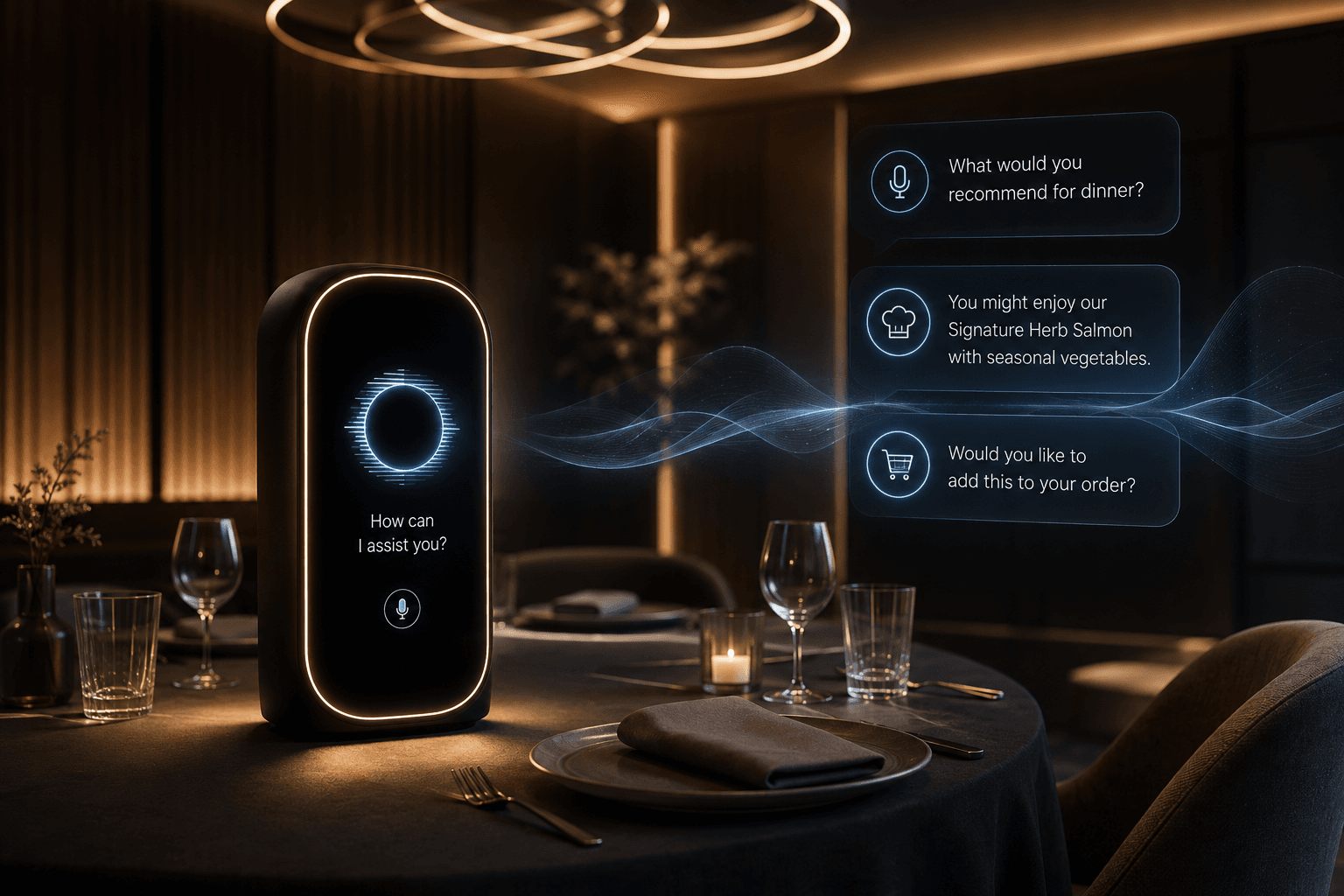
Imagine sitting down in a private dining room and simply asking:
“What would you recommend if I want something light but filling?”
Instead of searching through a digital menu or waiting for assistance, you can have a natural conversation and receive a relevant response.
You can then continue:
“Does that contain dairy?”
“What would go well with it?”
“Okay, I'll have that.”
This is the idea behind AIVORA Private Dining AI.
AIVORA is a voice-first AI assistant designed to make the private dining experience more convenient, interactive, and connected.
The goal isn't to replace the people who make hospitality special. AIVORA is designed to support them.
A waiter still brings the food to the table. A member of staff can explain something personally, clear plates, check on guests, handle special requests, and provide the human interaction that makes dining an experience.
AIVORA simply helps with some of the digital and repetitive interactions that can happen alongside that service.
What Is AIVORA?
AIVORA is an AI-powered digital assistant designed specifically for private dining environments.
Instead of functioning like a traditional chatbot with predefined buttons and commands, AIVORA is built around natural conversation.
Guests can ask questions, explore the menu, request recommendations, discuss dietary preferences, and eventually build and confirm orders through voice.
The broader vision includes:
Natural voice conversations
Intelligent menu assistance
Context-aware conversations
Dietary and allergen guidance
Personalised recommendations
Voice-assisted ordering
Reservation assistance
Kitchen communication
Restaurant management
Real-time order updates
The technology is intended to work alongside the restaurant team, not instead of them.
Why Voice?
People already communicate naturally through conversation.
When a customer asks a waiter:
“What would you recommend?”
they don't expect to fill out a form or navigate through several screens.
They simply ask.
AIVORA brings that same interaction model into a digital experience.
Instead of navigating through categories, filters, and menu items, a customer could simply say:
“Show me something vegetarian that's not too spicy.”
The assistant can understand the request and help the customer explore suitable options.
Voice doesn't need to replace traditional menus or human service. It simply provides another way for customers to interact with the restaurant.
From Questions to Conversations
One of the most interesting aspects of conversational AI is its ability to maintain context.
For example:
Customer:
“I'm looking for something spicy.”
AIVORA:
“We have a spicy chicken dish and a chilli seafood pasta. Would you prefer meat or seafood?”
Customer:
“What about the seafood one?”
AIVORA can understand that the customer is referring to the option mentioned previously.
The customer doesn't need to repeat the entire question.
This is what makes conversational AI different from a traditional search box. The customer doesn't need to construct the perfect query. They can simply have a conversation.
Intelligent Recommendations
Restaurant menus can contain many different dishes and combinations.
Sometimes customers know what they like without knowing exactly what they want.
A customer might say:
“I want something creamy, but I don't want anything too heavy.”
An intelligent assistant can use that preference to help narrow down the available choices.
Recommendations could eventually consider dietary preferences, allergens, ingredients, spice levels, previous selections, course progression, drinks, and menu availability.
The objective isn't simply to recommend the most expensive item.
It is to help customers discover options that genuinely match what they are looking for.
Dietary Requirements and Allergens
Dietary requirements and food allergies are an important part of the dining experience.
Customers may ask:
“Is this gluten-free?”
“Does this contain nuts?”
“What vegetarian options do you have?”
A restaurant AI system can help surface relevant information quickly, provided that the underlying restaurant information is accurate and properly maintained.
AIVORA is therefore designed around the principle that restaurant-provided information should remain the source of truth.
The AI should not simply guess when dealing with important information such as allergens or ingredients.
The long-term vision is to connect AIVORA with structured and verified restaurant data so customers can receive information based on the restaurant's actual menu.
From Conversation to Order
The most interesting part of AIVORA's vision is what happens after the conversation.
The assistant shouldn't necessarily stop after answering a question.
A customer could gradually build an order through natural conversation.
For example:
“I'll have the salmon.”
“Add the seasonal vegetables.”
“And a sparkling water.”
AIVORA could then present a clear order summary for the customer to review.
The customer can check the selected items and confirm the order before it is submitted.
This keeps the customer in control while allowing AI to make the ordering process more conversational.
Connecting the Dining Room to the Kitchen
AIVORA's vision extends beyond the customer-facing experience.
Once an order is confirmed, it could eventually move through the restaurant's operational systems.
A confirmed order could be sent to a kitchen display where staff can view the order, begin preparation, and mark it as completed.
The customer could then receive an update when the order is ready or when its status changes.
The restaurant team remains an essential part of this process.
The chef still prepares the food.
The waiter still serves the food.
Staff can still check on guests, answer complex questions, clear tables, bring additional items, and provide the personal attention that technology cannot replace.
AIVORA simply helps connect the digital side of the experience with the people running the restaurant.
One Platform, Multiple Experiences
A restaurant has different people interacting with the same operation.
Customers need a simple way to communicate with the restaurant.
Kitchen staff need clear and reliable order information.
Managers need visibility into operations.
AIVORA is designed with these different experiences in mind.
The customer experience focuses on conversation, menu discovery, recommendations, ordering, and updates.
The kitchen experience focuses on receiving and managing confirmed orders.
The management experience can eventually provide tools for menu management, restaurant configuration, order monitoring, analytics, and operational insights.
A central backend can connect these experiences while keeping each part of the system modular.
The Human Element Still Matters
Technology can answer a question quickly.
It can recommend a dish.
It can help build an order.
But there are parts of hospitality that are fundamentally human.
A staff member noticing that a guest needs something.
A waiter explaining a dish personally.
A chef preparing a meal with care.
Someone clearing the table after dinner.
A team making guests feel welcome.
These moments are what make hospitality hospitality.
AIVORA is designed to support those moments, not remove them.
By handling some repetitive digital interactions, AI can potentially give restaurant staff more time and attention for the guests themselves.
The AI Conversation Experience
At the centre of AIVORA is the conversation between the customer and the AI.
A typical interaction begins when the customer speaks.
Their voice is converted into text, the conversation context and relevant restaurant information are considered, and the AI generates a response.
That response can then be converted back into speech.
The goal is for this process to feel natural to the customer.
They shouldn't need to think about the technology behind the experience.
They simply speak, receive an answer, and continue the conversation.
The Importance of Reliable Restaurant Data
AI is only as useful as the information it has access to.
A restaurant assistant cannot reliably recommend dishes if it doesn't know what the restaurant actually serves.
A production AIVORA system would therefore need access to information such as:
Menu items
Ingredients
Prices
Allergens
Dietary classifications
Availability
Restaurant policies
Opening hours
Reservation information
Future versions could use technologies such as Retrieval-Augmented Generation (RAG), structured restaurant databases, and function calling to connect the AI with reliable restaurant information and operational systems.
This allows the AI to provide a useful conversational experience while keeping important business information controlled by the restaurant.
AI Working Alongside Hospitality Teams
The most important principle behind AIVORA is simple:
AI should assist hospitality teams, not replace hospitality.
Restaurant staff bring judgement, empathy, personality, and genuine human connection.
AIVORA can take care of some repetitive interactions, such as common menu questions, basic recommendations, order assistance, and simple information requests.
That can allow staff to spend more time doing what they do best: looking after people.
The future of restaurant technology doesn't have to be humans versus AI.
It can be humans supported by AI.
The Technology Behind AIVORA
The AIVORA prototype combines modern full-stack technologies with AI services.
The frontend uses React, Next.js, TypeScript, and Tailwind CSS.
The backend uses Node.js and Express.js with REST APIs.
The AI experience uses the OpenAI API together with speech-to-text, text-to-speech, prompt engineering, and conversational AI.
The prototype focuses on validating the core voice interaction and AI experience before expanding into the larger restaurant platform.
Building the Prototype
The first version of AIVORA was created to answer a simple question:
Can conversational AI provide a genuinely useful experience in a private dining environment?
Rather than attempting to build an entire restaurant platform immediately, the prototype focuses on the fundamental customer experience.
A customer can communicate naturally with the assistant, ask questions, receive AI-generated responses, and experience how voice interaction could work within a private dining environment.
This provides a foundation for gradually introducing more sophisticated restaurant capabilities.
Where AIVORA Could Go Next
The next stages could expand AIVORA from a conversational prototype into a connected restaurant platform.
This could include deeper menu integration, order management, kitchen displays, reservation systems, POS integrations, customer notifications, analytics, and restaurant management tools.
Additional AI capabilities could include multilingual conversations, personalised recommendations, restaurant-specific knowledge bases, customer preferences, and advanced automation.
Each capability can build upon the conversational foundation rather than requiring the entire system to be redesigned.
Why We Built AIVORA
The idea behind AIVORA came from a simple observation:
People already know how to talk to restaurants.
They ask questions.
They request recommendations.
They explain their preferences.
They change their minds.
They add something to their order.
They ask for help.
Traditional software often makes these interactions more structured than they need to be.
Conversational AI creates an opportunity to make restaurant technology feel more natural.
AIVORA explores what happens when the primary interface is not another complicated screen, but a conversation.
The Bigger Vision
AIVORA is ultimately about more than voice recognition or an AI chatbot.
It is about creating an intelligent layer that connects the guest experience with restaurant operations.
Imagine a future where a customer walks into a private dining room and simply says:
“AIVORA, what do you recommend tonight?”
The assistant understands the customer's preferences.
It knows the restaurant's menu.
It can answer questions.
It can provide recommendations.
It can help build an order.
The customer confirms the order.
The kitchen receives it.
The chef prepares it.
A waiter brings it to the table.
The restaurant team continues providing the personal service that makes the experience special.
And the customer can receive updates throughout the process.
That is the direction AIVORA is exploring.
The Future of Private Dining
Artificial intelligence is changing how people interact with software.
Restaurants are no exception.
The next generation of restaurant technology doesn't have to mean replacing the traditional dining experience with screens and automation.
Instead, it can mean using technology quietly in the background to make the experience smoother for both customers and staff.
AIVORA Private Dining AI is an exploration of that idea: combining voice, conversational intelligence, restaurant data, and connected workflows to create a more natural private dining experience.
Technology should not make hospitality feel less human.
It should give hospitality professionals more freedom to focus on being human.
Built by Pakhreen
Pakhreen explores and builds practical software, AI, automation, and digital solutions designed around real-world business problems.
AIVORA Private Dining AI is one of those explorations—bringing conversational AI into an industry where communication, personalisation, and human experience matter most.