PAKHREEN JOURNAL
Thoughtful engineering, design, and digital systems.
For years, developers have searched for tools that make software development faster without sacrificing quality. Today, Artificial Intelligence has become one of those tools — but perhaps not in the way many people expected.
The biggest misconception is that AI is here to replace developers.
It isn't.
Instead, AI is becoming one of the most powerful assistants a developer can have. It can write code, explain complex concepts, review thousands of lines of code, suggest improvements, and automate repetitive work. But it still lacks the creativity, judgment, and real-world decision-making that experienced developers bring to every project.
Can AI build an entire application on its own?
The short answer is no.
AI can generate code remarkably well, but software development is much more than writing code. Every project requires understanding business goals, designing scalable architecture, making security decisions, improving user experience, and solving unique problems.
Those responsibilities still belong to skilled developers.
Think of AI as an incredibly fast assistant that never gets tired—but still needs someone experienced to guide it.
Why use multiple AI tools instead of just one?
Every AI model has different strengths.
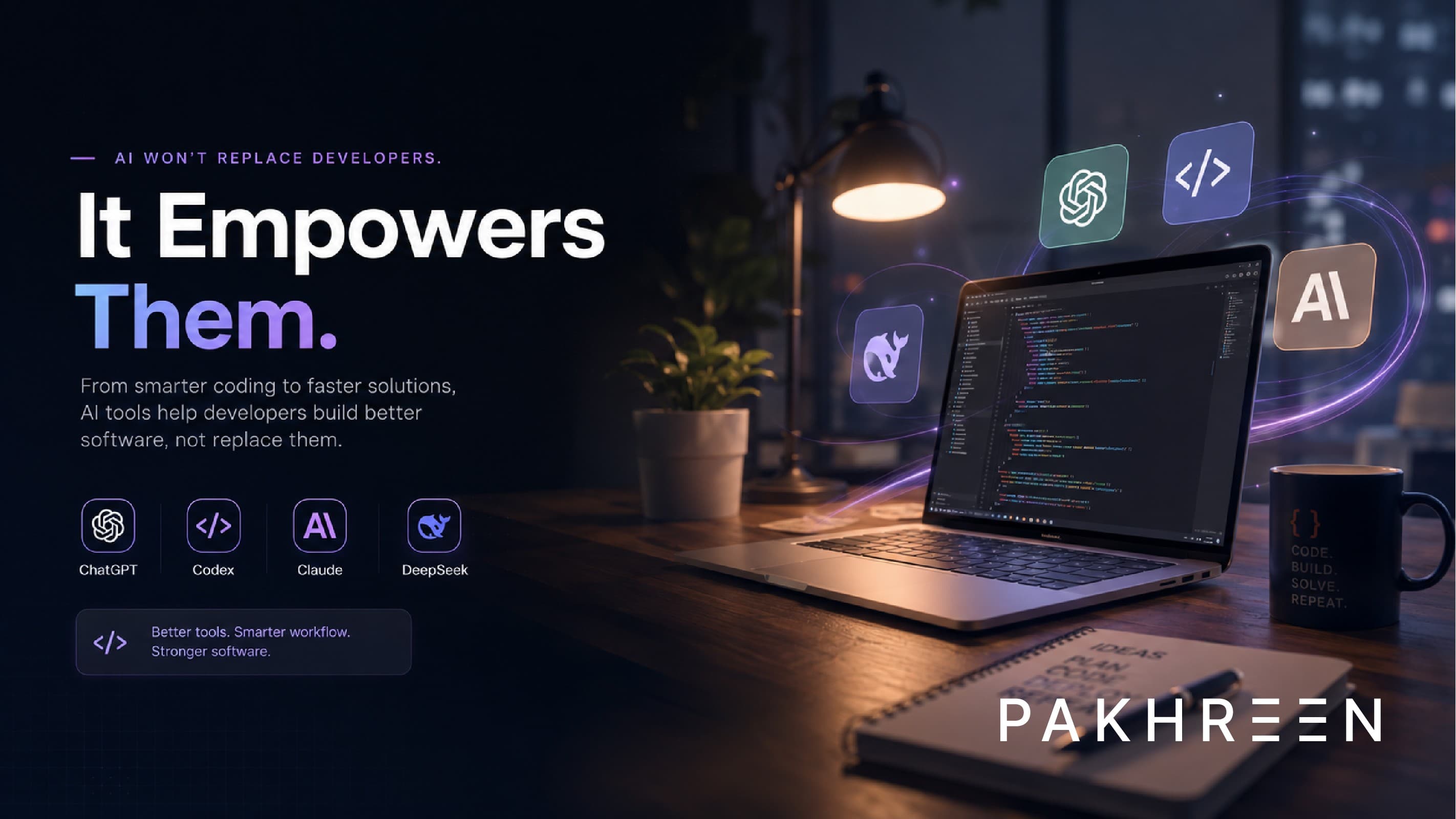
Rather than relying on a single assistant, developers often combine several tools to achieve better results.
Some of the most popular include:
ChatGPT – Excellent for brainstorming, explaining concepts, debugging, and generating documentation.
Claude – Great at understanding large codebases and reviewing long technical documents.
DeepSeek – Strong technical reasoning and alternative programming approaches.
Codex – Designed to speed up coding workflows and assist directly inside development environments.
Each tool approaches problems differently, and comparing their suggestions often leads to stronger, more reliable solutions.
How does AI actually save time?
Imagine spending thirty minutes searching documentation for a small issue.
Now imagine asking an AI assistant and receiving several possible solutions in seconds.
That doesn't mean the first answer is always correct — but it dramatically reduces the time spent researching.
Developers can then focus on what truly matters:
Solving business problems
Building better user experiences
Writing maintainable code
Improving security and performance
Instead of replacing expertise, AI allows developers to spend more time using it.
Is AI always correct?
Absolutely not.
This is one of the most important things to understand.
AI can produce outdated information, inefficient code, or solutions that simply don't fit the project. It may even sound completely confident while being wrong.
That's why experienced developers never copy AI-generated code directly into production.
Every suggestion should be reviewed, tested, improved, and validated before becoming part of a real application.
Human judgment remains the most important part of the development process.
Does AI improve software quality?
When used correctly, yes.
AI can assist with:
Detecting potential bugs
Suggesting cleaner code
Generating unit tests
Finding security risks
Improving documentation
Optimizing performance
These improvements allow developers to catch issues earlier, resulting in software that is more stable and easier to maintain.
Will AI replace software developers in the future?
Probably not.
It will replace certain repetitive tasks, but not the people responsible for building complete solutions.
Businesses don't simply need code — they need software that is secure, scalable, reliable, and designed around real users. Those decisions require communication, creativity, planning, and experience.
AI can generate code.
Developers create products.
That difference is significant.
The Future Is Collaboration
The future of software development isn't about humans competing with artificial intelligence.
It's about combining the speed of AI with the creativity, experience, and critical thinking of skilled developers.
As AI continues to evolve, developers who learn to work alongside these tools will build software faster, solve problems more efficiently, and deliver better experiences for users.
AI doesn't replace developers.
It empowers them to focus on what humans do best — thinking, creating, innovating, and building technology that makes a real difference.