PAKHREEN JOURNAL
Thoughtful engineering, design, and digital systems.
Work Smarter, Not Harder
Every business has tasks that are repeated day after day. Responding to customer inquiries, updating spreadsheets, sending invoices, creating appointments, notifying team members, or copying information between different systems may seem small on their own, but together they consume hours of valuable time every week.
Now imagine those tasks happening automatically.
A customer submits an inquiry through your website. Within seconds, they receive a confirmation email, your team is notified, the customer's details are saved to your CRM, and AI categorizes the inquiry based on its urgency and topic. Before you even open your inbox, the work has already begun.
This is the power of AI automation workflows.
Businesses are no longer using automation simply to save time—they're using it to deliver better customer experiences, reduce operational costs, and stay ahead of the competition.
What Is an AI Automation Workflow?
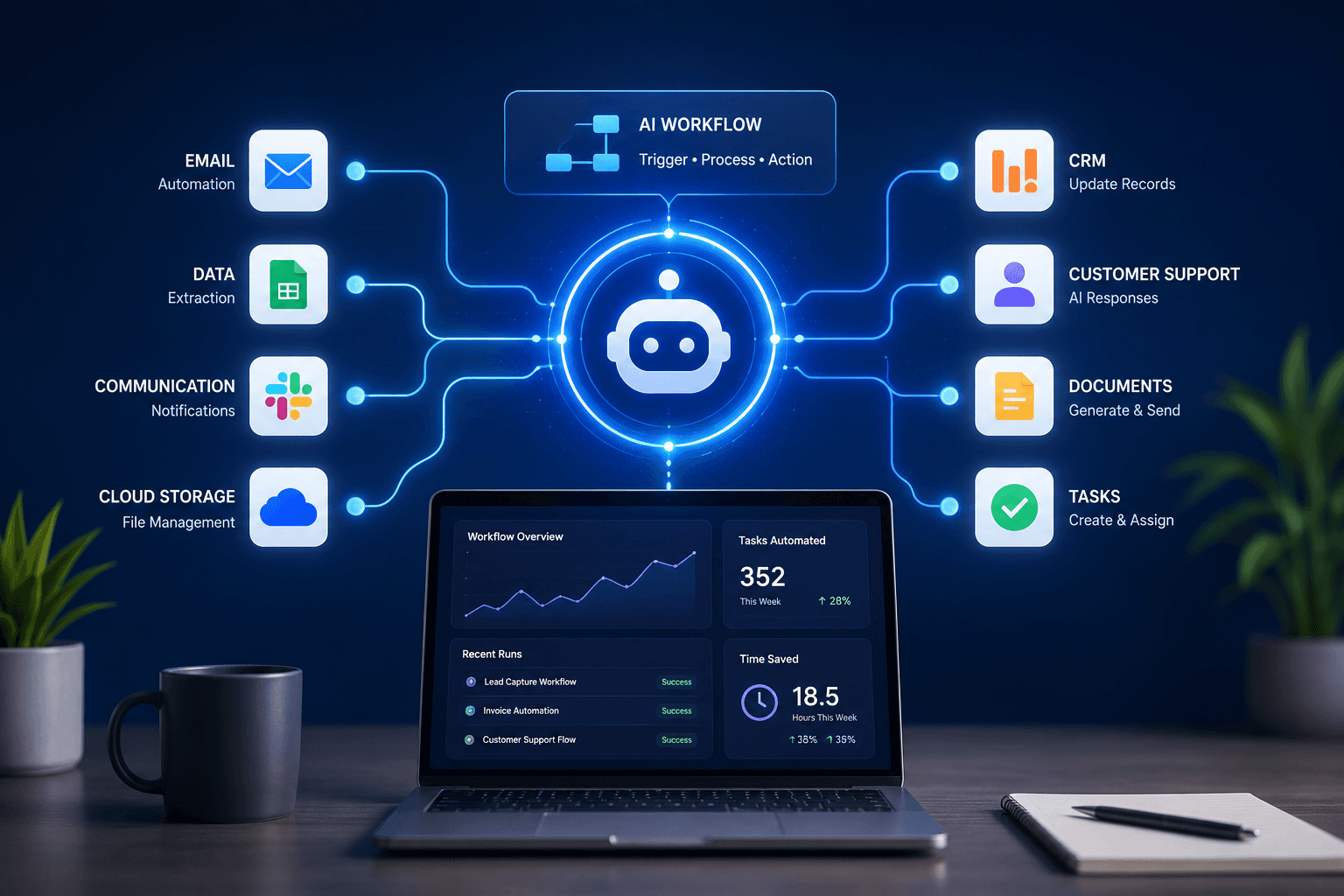
An AI automation workflow is a sequence of intelligent actions triggered automatically when something happens.
Unlike traditional automation that follows simple "if this, then that" rules, AI automation can understand language, analyze information, make recommendations, summarize content, and even generate responses.
For example:
Customer submits a contact form → AI reviews the inquiry → Customer receives a confirmation email → Team receives a notification → Lead is saved to the CRM → A follow-up task is created automatically.
The entire process happens in seconds without manual intervention.
Why Businesses Are Investing in AI Automation
Time is one of the most valuable resources in any business. Every hour spent on repetitive administrative work is an hour not spent serving customers, improving products, or growing the business.
AI automation allows businesses to shift their focus from repetitive work to meaningful work.
Key Benefits
Save hours of manual work every week
Respond to customers instantly
Reduce costly human errors
Improve consistency across business processes
Increase productivity without increasing workload
Deliver faster and better customer experiences
Connect multiple business applications seamlessly
Scale operations without hiring additional staff
Allow employees to focus on higher-value tasks
Automation doesn't replace people—it empowers them by eliminating repetitive tasks that don't require human creativity or decision-making.
Common AI Automation Workflows
Every industry has processes that can be automated. Here are some of the most common examples.
Customer Support
Instead of manually replying to every inquiry, AI can:
Answer frequently asked questions
Route requests to the correct department
Summarize conversations
Draft professional email responses
Escalate urgent issues automatically
Customers receive faster responses while your team spends more time solving complex problems.
Sales and Lead Management
Every new lead is valuable, but manually processing inquiries can slow down your sales process.
An automated workflow can:
Capture leads from your website
Qualify prospects using AI
Send personalized follow-up emails
Notify your sales team instantly
Create CRM records automatically
Schedule follow-up reminders
This helps ensure no opportunity is missed.
Marketing Automation
Marketing involves countless repetitive tasks that AI can handle efficiently.
Examples include:
Creating social media captions
Scheduling content across platforms
Sending newsletters
Personalizing customer emails
Tracking campaign performance
Generating marketing ideas
Your marketing team can spend less time on administration and more time creating impactful campaigns.
Finance and Administration
Administrative work often involves repetitive data entry and document management.
AI automation can:
Generate invoices
Send payment reminders
Organize business documents
Process approvals
Update accounting systems
Track recurring payments
The result is faster operations with fewer mistakes.
Human Resources
Hiring and onboarding new employees can also be streamlined.
Automation can:
Collect applications
Screen resumes
Schedule interviews
Send onboarding emails
Organize employee documents
Answer common HR questions
This creates a smoother experience for both employers and candidates.
Real-World Example
Imagine a visitor fills out the contact form on your website.
Instead of waiting for someone to manually process the request, the workflow immediately:
Validates the submitted information
Sends a professional confirmation email
Alerts the appropriate team member
Saves the inquiry in your CRM or database
Categorizes the inquiry using AI
Creates follow-up tasks automatically
Within seconds, everything is organized and ready for action.
The customer receives a faster response, and your team saves valuable time.
Popular AI Automation Platforms
Modern automation platforms connect hundreds—or even thousands—of applications, making it easier than ever to automate workflows.
Some of the most widely used platforms include:
n8n
Zapier
Microsoft Power Automate
OpenAI
Google Workspace
Slack
Gmail
Stripe
HubSpot
Notion
Airtable
The right solution depends on your business goals, existing software, and the level of customization you require.
Is AI Automation Only for Large Businesses?
Not at all.
In fact, small and growing businesses often benefit the most because every hour saved has a significant impact.
You don't need a large IT department or enterprise budget to start automating your business.
Many companies begin with a single workflow—such as automating customer inquiries or invoice reminders—and gradually expand as they see the benefits.
Small improvements made consistently can create major long-term gains.
How to Get Started
Before investing in automation, identify repetitive tasks within your business.
Ask yourself:
Which tasks are performed every day?
Where do mistakes happen most often?
Which processes require copying information between systems?
What delays your customers?
Which activities consume the most staff time?
The answers will often reveal excellent opportunities for automation.
Start with one workflow, measure the results, and improve over time.
Key Takeaways
AI automation workflows connect your business systems to work together intelligently.
They reduce repetitive manual work while improving speed and accuracy.
Automation helps businesses deliver better customer experiences.
Teams become more productive by focusing on meaningful work instead of administration.
Small businesses can benefit just as much as large enterprises.
Starting with one well-designed workflow often delivers immediate value and provides a strong foundation for future automation.
The Future of Business Is Intelligent Automation
AI automation is no longer a luxury reserved for large corporations. It has become an accessible and practical solution for businesses that want to improve efficiency, reduce operational costs, and deliver exceptional customer experiences.
Whether you're automating customer inquiries, streamlining internal operations, or connecting multiple business systems, AI automation can transform the way your business works.
At Pakhreen, we build tailored AI automation workflows that integrate seamlessly with your existing tools and processes. Our goal is simple: eliminate repetitive work, simplify complex operations, and help your business operate smarter—so you can focus on growth, innovation, and serving your customers.